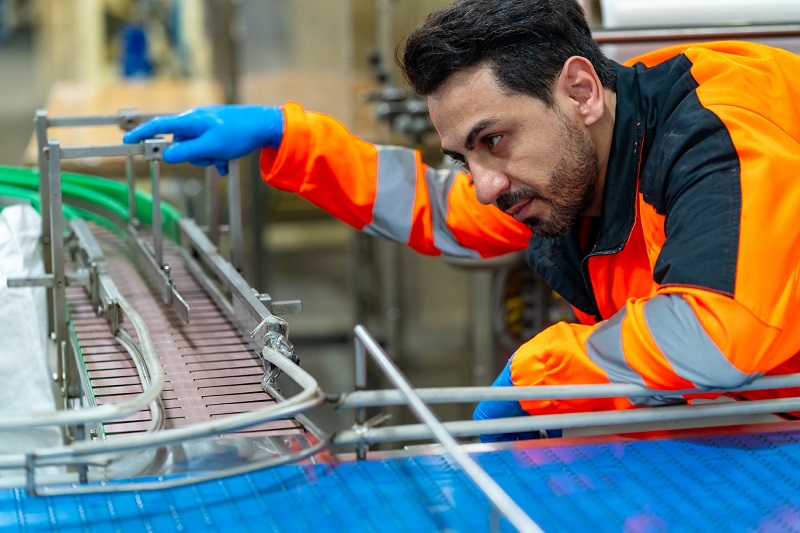
There was a time when VHS was cutting-edge, revolutionising how we watched our favourite films, but compared to the streaming services we have today, you see just how far the world has moved on. Traditional conveyor systems are the VHS of manufacturing. While they’ve served the industry for decades, today’s production demands more flexibility, more precision and much greater speed than what conventional transport mechanisms can realistically deliver. Here, Mark Richards, UK sales manager at automation and control specialist Beckhoff, explains why it’s time to start looking for alternative options for production lines.
In modern manufacturing, customisation, varying batch sizes and rapid changeovers are the norm. With flexibility becoming more and more important, production speed needs to increase or face serious bottlenecks.
Conventional transport systems like conveyor belts are built for moving items from A to B in a linear, rigid and mechanical fashion. This means to increase speed or directionality, multiple conveyors need to be placed in series, multiplying machine footprint and taking up a lot of floor space.
When adapting to new product types or process changes, significant mechanical reconfigurations would need to take place, which increases downtime. Although once a standard and reliable piece of technology, the rigidity of conveyors is putting pressure on throughput, energy use and product quality. The problem is even more pressing in industries where precision and cleanliness are non-negotiable.
Sector-specific strain
In semiconductor production, micron-level handling and ultra-clean, dust-free environments are standard practice. Vibrations and inconsistent speeds from traditional systems create a real risk of damage to delicate wafers, where every physical contact point is a liability. Belts and chains are fundamentally a mismatch to the demands of next generation chipmaking.
In battery manufacturing, there is an issue of weight, safety and scalability. Battery cells and modules can be heavy and fragile, often requiring exact positioning during processes like welding and assembly. A reliably consistent level of control is required for safe handling, which conventional conveyors struggle provide. With increasing pressure on electric vehicle supply chains, high throughput and proper traceability are requirements for the battery industry.
In sectors like medical devices, where there is a high variance in product formats, operations are expected to run smoothly despite the frequent changes. Whether they’re therapeutic or diagnostic devices, flexibility while complying with strict regulations is a top priority. This makes it hard to justify using rigid mechanical transport systems that introduce unnecessary complexity into what should be a responsive, adaptive process.
Intelligent motion solutions
With PC-based control, entirely new production possibilities can be realised and with modular automation technology, operations can change even without the flick of a switch.
Beckhoff offers software-defined transport systems that brings motion control into the digital age. XPlanar uses planar tiles and contactless, levitating movers to achieve omnidirectional motion with zero mechanical abrasion. With this, products can move simultaneously in any direction, tilt, rotate or float in clean and sensitive environments. It allows truly adaptive production lines where layouts and process steps can be redefined by software alone.

XTS takes efficiency to another level, combining the benefits of rotary and linear drive systems as an ultra-fast, intelligent linear transport solution. Movers glide along a continuous track with individually programmable motion profiles that can perform micro adjustments to adapt to spatial variability. XTS excels in high-throughput environments and enables continuous product flow by adjusting parameters instantly in software.
In a world increasingly driven by automation and data, conveyors often remain one of the last holdouts of purely mechanical technology. In today’s manufacturing landscape, being able to track machine feedback, meet traceability requirements and secure quality control is vital. With a modular layout, intelligent motion solutions can also adapt to existing legacy equipment and make an operation scalable.
Rediscover transport on production lines and find out more about Beckhoff’s intelligent motion solutions on the website